How to Choose a Crypto Wallet in Russia in 2026
This article mentions OneSix, a product of the company that owns this blog. It is not an independent wallet ranking, and we state plainly where other solutions are the better choice.
There is no universally best wallet: the right choice depends on what you intend to do with the crypto. Long-term savings, active trading and everyday spending in Russia call for different tools, and trying to cover all three with one app usually ends in either lost access or unnecessary costs. Below are the three questions to answer before choosing, and what actually fits each scenario — including the points that matter specifically if you are a foreign national living in Russia.
Three questions to answer first
What are you doing with the asset? Holding it as savings and touching it twice a year. Trading it. Receiving income in USDT and spending it. These are three different jobs with different requirements.
How much, and for how long? For an amount you cannot afford to lose under any circumstances, control over access is the priority. For working funds that pass through the wallet every week, convenience and speed are.
Where do you spend? If your expenses are in Russia and in rubles, the choice of wallet is inseparable from the question of how rubles come out of it. A wallet with an excellent interface that offers no viable exit route in your jurisdiction does not solve your problem.
Who controls access to the funds
This is the main distinction between solutions, and the one most often left unexplained. There are two approaches.
You hold the keys. When you create the wallet you receive a secret recovery phrase, and access depends on nothing else. Nobody can freeze your balance and nobody can restore it. Lose the phrase and the funds are gone, with no one to appeal to. That is the price of full control.
The service controls access. You log in with an account, a phone number or a messenger, and recovery is possible. In exchange you rely on the service's integrity and resilience: its rules, its checks and its outages become yours.
Neither approach is better in the abstract. The sensible practice is to separate them: long-term savings where you hold the keys, working funds where paying and cashing out is easier. Keeping everything in one place is a risk regardless of what that place is.
Formats and what each is good for
Hardware devices. A separate physical device where the keys never leave the hardware. The best option for holding significant amounts long term. Downsides: it costs money and demands care at purchase — buy only from official sellers, since a device arriving with someone else's recovery phrase preloaded means instant loss. Inconvenient for daily spending. Worth noting that delivery to Russia is not always straightforward, so plan the purchase in advance rather than in a hurry.
Apps where you hold the recovery phrase. Free, run on a phone, support many networks. Suitable for moderate amounts and active use if you understand networks, fees and addresses. The main risk is mundane: a phrase saved in notes or cloud storage is the most common way people lose a balance.
Wallets inside services and mini apps. Registration takes minutes, you rarely need to think about networks, and ruble operations are often built in. Suitable for working funds and everyday tasks. The limitation is that you depend on the service's rules, so large savings do not belong here.
Exchange accounts. Formally not a wallet but an account on a trading platform. Necessary for trading, poor as a primary place to hold funds: access conditions can change faster than you can react.
What to check in 2026
Availability for your situation. Verify this before funding anything. Some platforms restrict registration or specific functions by citizenship, residency or the documents you can provide, and a passport issued outside Russia can behave differently in verification than a domestic one. Discovering this at the moment of withdrawal is the worst-case sequence.
Supported networks. USDT exists on several networks, an address on one does not work on another, and fees and speed differ by orders of magnitude. The wallet must support the network people actually send you funds on, and the interface should make it hard to confuse networks when sending.
Transparent costs. Look past the stated fee to the outcome: how much the recipient gets and how many rubles reach your account on conversion. Some services earn on the spread, which appears in the interface as "no fee". The rate and the final amount should be visible before you confirm, not after.
What happens when checks are triggered. Any service touching fiat screens incoming funds. What matters is what follows: whether funds are returned to the sender, whether documents are requested, and whether there is a comprehensible procedure at all. The absence of an answer in a service's public materials is itself a signal.
The route to rubles. The decisive criterion for anyone living in Russia. Is there withdrawal to a card and via SBP, can you pay a ruble bill directly, or is the only path a P2P trade with a stranger — which brings the risk of your card being restricted.
Support and visible track record. A working support channel, a public update history, reviews outside the service's own website. Language matters here too: support that operates only in Russian is a practical constraint if you need to explain a stuck transaction precisely.
Matching the tool to the scenario
- Savings held for years. A hardware device, with the phrase written on paper and stored offline. Everything else is secondary.
- Active trading. A platform account, but only for the volume you actually trade; the remainder goes where you hold the keys.
- Income in USDT from foreign clients. An app that makes receiving funds and issuing invoices straightforward, plus a clear route into rubles and saved documentation for every operation — you will need it for the bank and the tax authority.
- Everyday spending in Russia. A solution where rubles go directly to the payee, with no intermediate transfer landing on your card from a stranger.
- First steps with a small amount. Anything simple, but build the habits immediately: check the network before sending, and make a test transfer for a token amount first.
Where OneSix fits
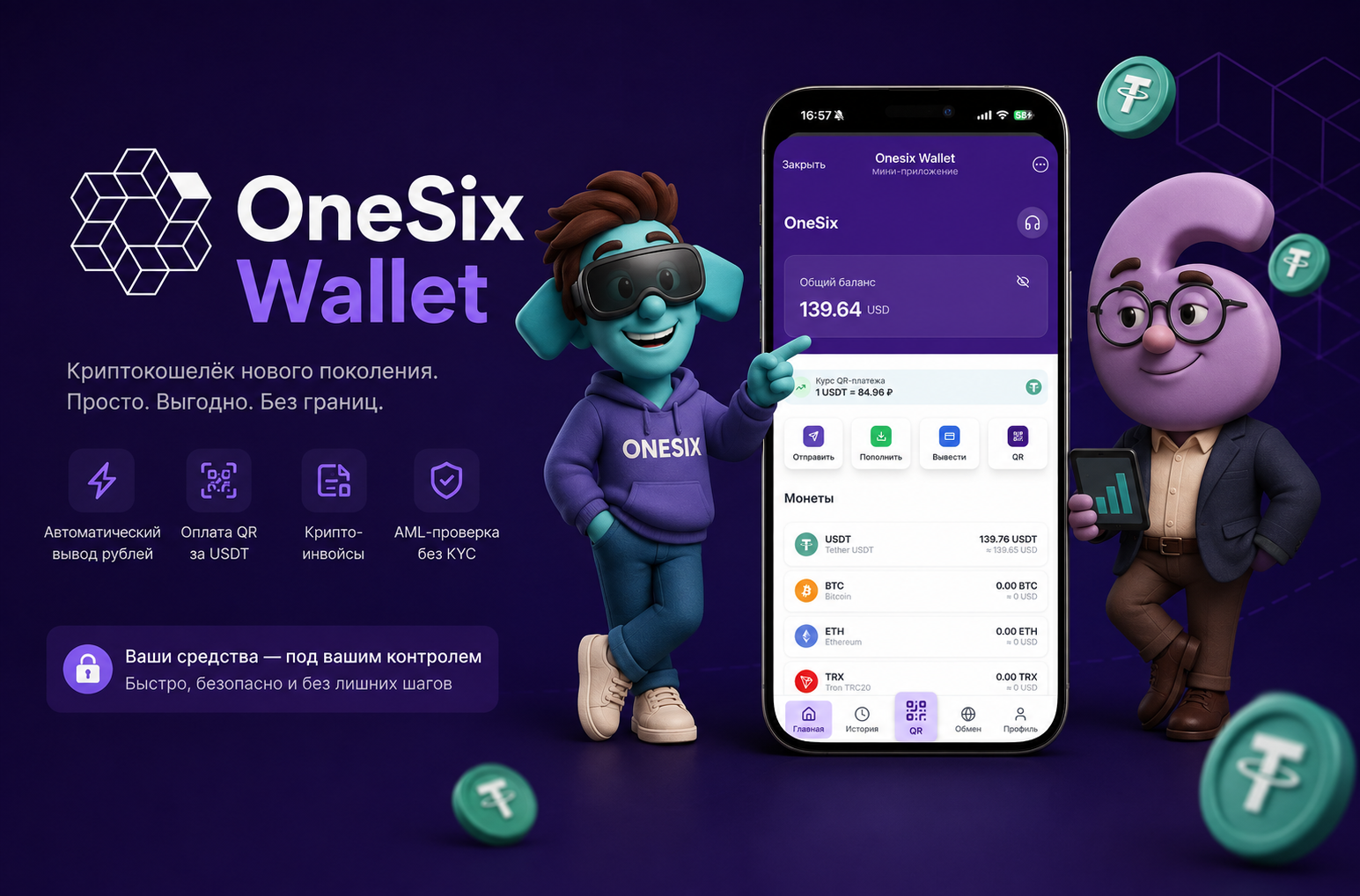
OneSix covers the last scenario — everyday spending in Russia while your balance is in USDT. It is a Telegram mini app, so there is no separate program to install and you enter through the messenger. The primary asset is USDT across several networks; check the current list of supported coins and networks in the app itself.
What it does that general-purpose wallets do not: payment of ruble SBP QR codes with USDT converted to rubles, withdrawal to a card and via SBP, and crypto invoices for freelancers and businesses. When you pay a QR code the merchant receives an ordinary ruble payment, and no money from an unknown buyer reaches your card — which removes the main source of card restrictions we covered in a separate article on cards being blocked after a USDT sale.
Where OneSix is not the right tool, stated plainly:
- Holding large savings. The service controls access, not you. For funds you do not touch, a hardware device is objectively safer.
- Trading. This is not an exchange: there is no order book and no trading tooling.
- Chasing the best rate. For a large one-off sale, P2P on an exchange usually yields more rubles for the same USDT. We compare the routes in a separate article.
- Broad multi-asset use. General-purpose wallets support noticeably more networks and tokens.
A sensible setup for someone earning in USDT is not one wallet for everything, but a split: savings in one place, working funds and daily payments in another.
What to avoid
Wallets advertised with promised returns. A wallet stores funds; it does not generate a yield. A promise of returns means you are not looking at a wallet.
Installing apps from links in chats or search ads. Counterfeit wallets are a common theft vector. Install only from official app stores and links on the developer's own site.
Storing the recovery phrase digitally. Notes, photo galleries, cloud storage and chat history are the first places attackers reach. Real support never asks for that phrase; any such request is fraud.
Promises of anonymity. A service marketing itself on invisibility to banks and authorities is promising something it cannot deliver, and the resulting risk lands on you rather than on it.
Moving your whole balance to a new service at once. Make the first operation a test one for a minimal amount, and follow the route all the way through, including the exit.
Related questions
Are crypto wallets legal in Russia?
Yes. Digital currency is recognised as property, and owning or storing it is not prohibited. What is prohibited is accepting digital currency as payment for goods, work and services inside the country, under Part 6, Article 1 of Federal Law No. 282-FZ.
Can I pay with crypto in a shop?
No. The lawful sequence is different: the digital currency is sold for rubles and the merchant receives a ruble payment. That is how services allowing you to settle a ruble bill from a USDT balance operate.
How many wallets do I need?
Usually two: one for holding, where you control the keys, and one for working funds and payments. That limits the damage from any single problem, from a lost phone to a service outage.
What if I lose access to my wallet?
If you held the keys and the recovery phrase is gone, the funds cannot be restored — that is a property of the technology, not a policy. If the service controls access, contact its support through the official channels listed on its site or in the app, and never respond to anyone offering help in private messages.
Sources
- Federal Law No. 282-FZ of 4 August 2026 "On Digital Currencies and Digital Rights" (in Russian)
- Official publication of Law No. 282-FZ, pravo.gov.ru (in Russian)

Aleksandr Lebedev
Analyst at OneSix. Covers payment regulation and payment infrastructure in Russia and the CIS, and is responsible for the factual accuracy of this blog.
Published: . Updated: .
We cover regulatory updates in the OneSix Telegram channel.
This material is for information only and does not constitute investment, tax or legal advice.