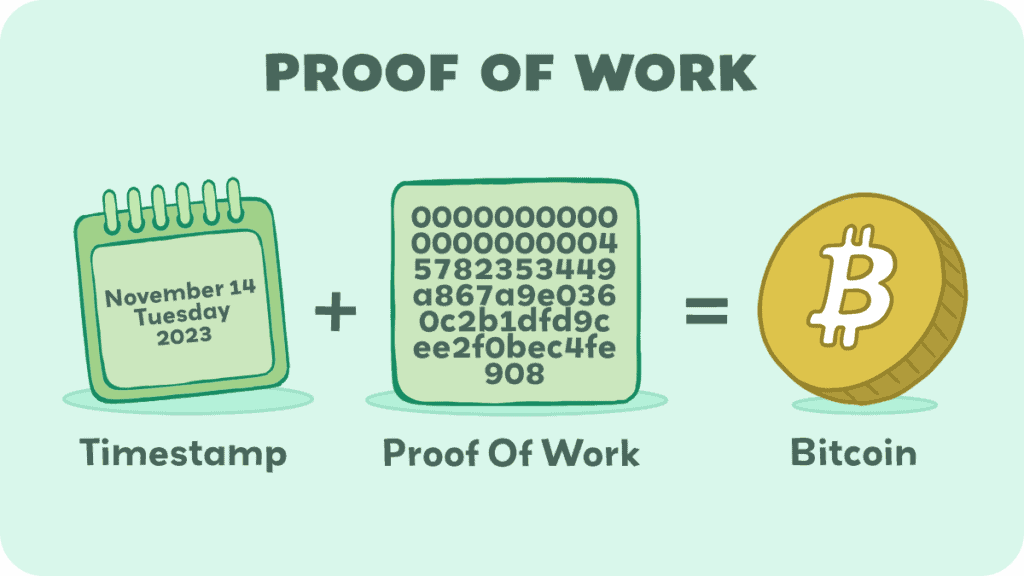
What Is Proof-of-Work? Consensus Mechanism Explained Simply
Proof-of-Work (PoW) is a consensus mechanism used in blockchain networks to validate transactions and add new blocks to the chain. It is the foundation on which Bitcoin and several other cryptocurrencies operate. If you have heard the word "mining", PoW is exactly what makes it work.
Let's break down how it works, why it exists and why PoW is still considered one of the most reliable ways to secure a blockchain.
Why a consensus mechanism is needed at all
A blockchain is a distributed database: it is not stored in a single location but is spread across thousands of computers around the world. Nobody holds a single "master" copy. A mechanism is therefore needed that allows all network participants to agree on which transactions are valid and which are not.
Without such a mechanism, an attacker could send the same coin to two recipients at once (known as a "double spend") or insert forged blocks into the chain. Proof-of-Work solves this problem by requiring participants to prove that they spent real computational resources.
How Proof-of-Work works: a simple example
Imagine a puzzle: you need to find a number that, when added to a given piece of text, produces a hash (a digital fingerprint) that starts with several zeros. The only way to find this number is by brute force — billions of attempts per second. This is exactly what miners do.
When a miner finds the right answer, they broadcast it to the network. Every other participant instantly verifies the solution (this is trivially easy), agrees, and adds the new block to the chain. The miner is rewarded with freshly created coins and transaction fees.
Key Proof-of-Work concepts
- Hash — a unique digital "fingerprint" of a block. Even the tiniest change in data produces a completely different hash.
- Nonce — a random number that miners cycle through in search of the required hash.
- Mining difficulty — a network parameter that adjusts automatically to keep a new block appearing roughly every 10 minutes (in Bitcoin's case).
- Hashrate — the total computational power of the network. The higher the hashrate, the harder it is to attack the blockchain.
Why PoW is considered secure
To rewrite transaction history or insert a forged block, an attacker would need to control more than 51% of the entire network's computational power. For Bitcoin, this means hardware and electricity costs comparable to the budgets of major corporations. The attack is simply not economically viable.
This is why Bitcoin, running on PoW for over 15 years, has never been successfully compromised at the protocol level. The real cost of computation is the physical security of the network.
How Proof-of-Work differs from Proof-of-Stake
Proof-of-Stake (PoS) is an alternative consensus mechanism used, for example, by Ethereum after its transition (The Merge) in 2022. In PoS, instead of computation, participants "stake" their coins as collateral and earn the right to validate transactions proportional to their share.
| Parameter | Proof-of-Work (PoW) | Proof-of-Stake (PoS) |
|---|---|---|
| Network security | Computational power | Coin collateral |
| Energy consumption | High | Low |
| Accessibility | Hardware required | Coins required |
| Used by | Bitcoin, Litecoin, Monero | Ethereum, Solana, Cardano |
| Attack resistance | Very high (economic) | High (financial) |
Which cryptocurrencies use Proof-of-Work
- Bitcoin (BTC) — the original PoW coin, SHA-256 algorithm.
- Litecoin (LTC) — the "silver" of crypto, Scrypt algorithm.
- Monero (XMR) — privacy-focused, RandomX algorithm.
- Bitcoin Cash (BCH) — a Bitcoin fork, same SHA-256 algorithm.
- Dogecoin (DOGE) — originally a meme coin, runs on Scrypt.
Pros and cons of Proof-of-Work
Pros:
- Battle-tested reliability: Bitcoin has run without a protocol failure for over 15 years.
- Real physical security — attacking the network requires enormous hardware and electricity costs.
- Decentralisation: anyone can become a miner, with no single controlling centre.
Cons:
- High energy consumption.
- Specialised hardware (ASIC miners) is needed.
- Risk of mining centralisation in the hands of large pools.
How PoW relates to cryptocurrency prices
Mining difficulty and the cost of producing one Bitcoin form a kind of "price floor": when the price falls below the cost of mining, some miners shut down, difficulty drops and mining becomes profitable again. This is a built-in economic pendulum that keeps the network running regardless of market conditions.
If you are interested in how pricing works in PoS networks and what analysts forecast for Ethereum in 2026, read our in-depth article: ETH Price Forecast for 2026 and How to Spend Crypto Conveniently.
How to use cryptocurrency conveniently in Russia
Even after mastering PoW and PoS mechanics, there remains a practical question: how do you actually spend crypto in Russia without risking card blocks and P2P withdrawal headaches?
The classic route — exchange → P2P → bank card — is becoming increasingly risky as banks tighten AML controls and any connection to flagged services can freeze an account. The optimal approach is to convert crypto into ruble payments via a service that handles all compliance and pays merchants directly through SBP.
OneSix: pay with crypto anywhere a QR code exists
OneSix is a Telegram wallet that lets you store USDT and pay for any purchase using SBP QR codes. Yandex services, Ozon, Wildberries, airline tickets, hotels, food delivery, online stores — anything that accepts SBP QR is available to you for crypto.
The merchant receives regular rubles; you spend USDT without P2P chains, card risks or lengthy compliance checks. AML control is built into the service: suspicious funds are rejected and returned to the sender.
How to get started with OneSix
- Open the bot on Telegram: @onesix_wallet_bot
- Create a wallet — no mandatory KYC.
- Top up your USDT (TRC-20) balance with zero deposit fee.
- Scan an SBP QR code in a store or on a website — OneSix converts your USDT to rubles and completes the payment for you.
This material is for informational purposes only and does not constitute financial or legal advice.
